
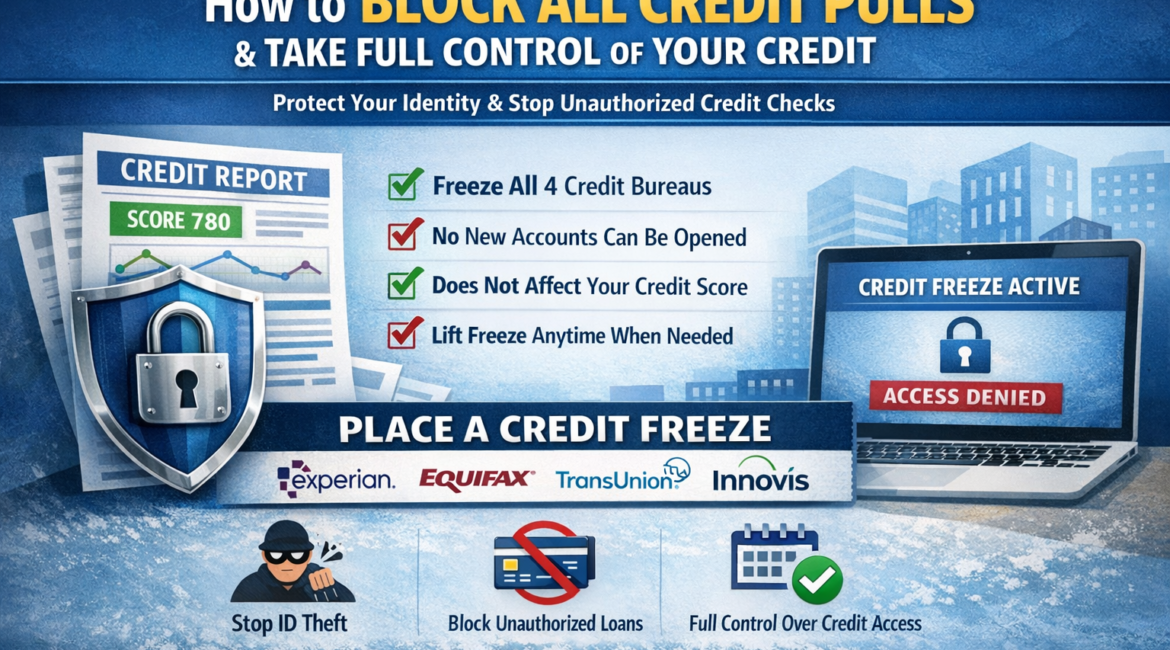
In today’s digital world, protecting your credit is just as important as protecting your identity. If you want to stop lenders, creditors, and companies from pulling your credit unless you explicitly approve it, there is a proven and legal solution: a credit freeze.
This article explains what a credit freeze is, how it works, and how to properly block all credit bureaus so your credit cannot be accessed without your consent.
What Is a Credit Freeze?
A credit freeze (also known as a security freeze) is a free protection tool that prevents lenders and creditors from accessing your credit report. When your credit is frozen:
- No new credit accounts can be opened in your name
- No hard credit inquiries can be performed
- Your credit score is not affected
- Existing accounts remain unchanged
Only you can lift or temporarily remove the freeze using secure login credentials or a PIN.
Why Freezing Your Credit Matters
Freezing your credit is one of the most effective ways to prevent:
- Identity theft
- Unauthorized loans or credit cards
- Surprise credit inquiries
- Credit score damage caused by fraudulent activity
Even if someone has your Social Security number, they cannot open credit while your report is frozen.
You Must Freeze All Credit Bureaus
There is no single national credit block. To fully protect yourself, you must place a credit freeze with each credit bureau individually.
The Four Credit Bureaus to Freeze
- Experian
- Equifax
- TransUnion
- Innovis (often overlooked, but still used by some lenders)
⚠️ If even one bureau is not frozen, credit may still be pulled.
Is a Credit Freeze Free?
Yes. Under U.S. federal law, credit freezes are 100% free and must remain free indefinitely. You are never required to pay to freeze or unfreeze your credit.
How to Temporarily Allow a Credit Pull
When you are ready to apply for a mortgage, auto loan, credit card, or rental, you can temporarily lift the freeze:
- For a specific date range
- For only one credit bureau
- For a specific lender (depending on bureau options)
Most freezes can be lifted instantly online or through a mobile app.
Once the timeframe expires, the freeze automatically resumes.
Credit Freeze vs. Credit Lock
Many credit bureaus advertise “credit lock” services, but they are not the same.
| Feature | Credit Freeze | Credit Lock |
|---|---|---|
| Cost | Free | Monthly fee |
| Backed by federal law | Yes | No |
| Blocks credit pulls | Yes | Yes |
| Requires subscription | No | Yes |
For most consumers, a credit freeze offers stronger protection at no cost.
Does a Credit Freeze Affect Existing Credit?
No. A credit freeze does not impact:
- Your current credit cards
- Your mortgage or auto loan
- Your ability to pay bills
- Your credit score
You can still use your existing credit normally.
Who Should Freeze Their Credit?
A credit freeze is especially recommended if you:
- Are not actively applying for credit
- Want protection against identity theft
- Have experienced a data breach
- Are planning a future home or auto purchase
- Want full control over when your credit is accessed
Many people now keep their credit frozen by default and only unfreeze when necessary.
Final Thoughts
If you want to completely block credit pulls unless you personally approve them, a credit freeze is the safest, simplest, and most effective solution.
By freezing all four credit bureaus, you stay in full control of your financial identity — no surprises, no unauthorized inquiries, and no unnecessary risk.
Disclosure
This content is provided for general informational purposes only and does not constitute legal, credit, or financial advice. We are not credit repair specialists, credit counselors, or attorneys. Credit bureau practices, consumer rights, and applicable laws and regulations are subject to change without notice.
Readers should independently verify information and consult with qualified professionals regarding their specific credit or financial situation. Use of this information is at the reader’s own discretion.